
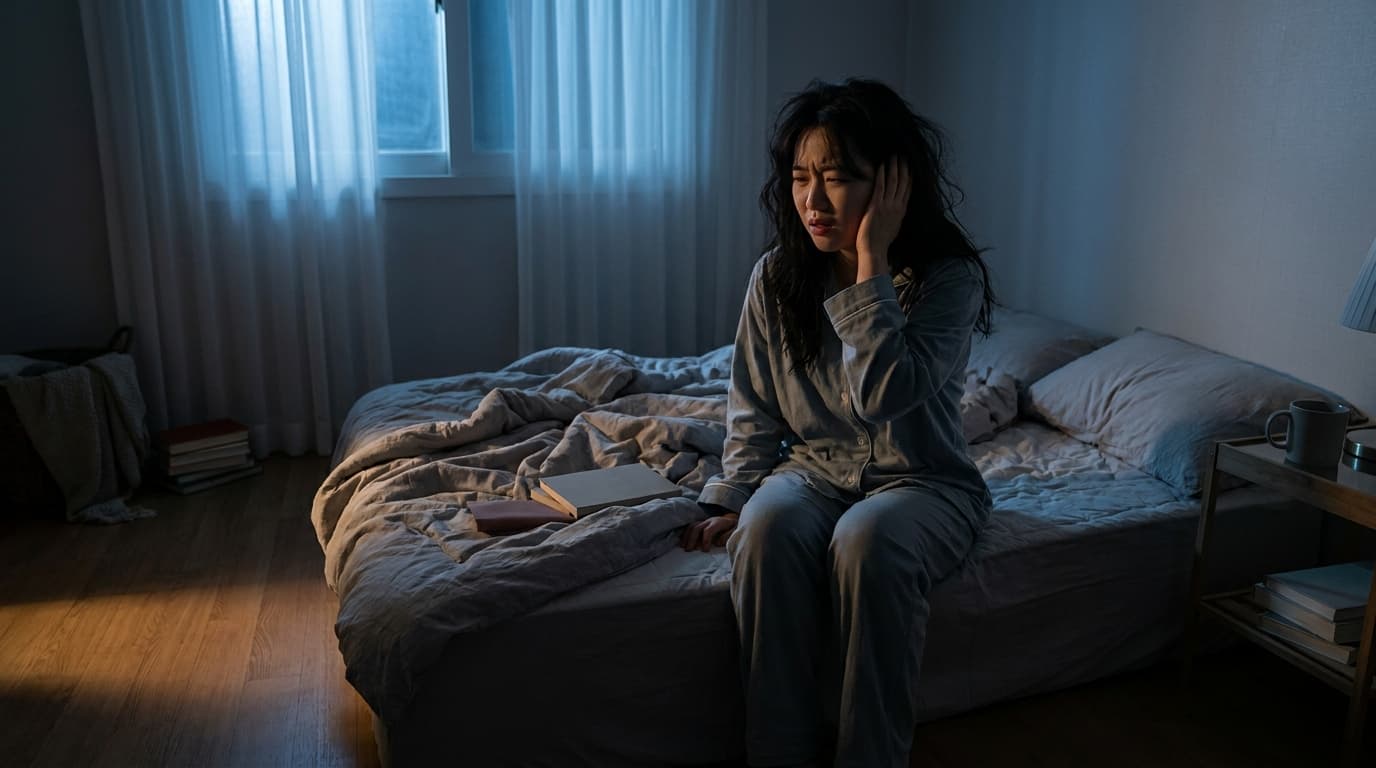
Hello. This is Dalimchae Korean Medicine Clinic. When you suddenly hear a ringing or machine-running sound in your ear, and it becomes clearer whenever you are tired, many people suffer in distress. Especially because it is a sound only you can hear, suffering alone leads to chronic fatigue and stress. When you go to bed, it feels louder, leading to sleepless nights and a sharp drop in quality of life. Such symptoms can be a sign that the delicate balance of our body has broken, beyond a simple ear problem.
💡 [Key Answer] Top 3 most common causes of machine-like sounds in the ear: ① Autonomic imbalance / ② Hearing system hypersensitivity / ③ Chronic fatigue and stress Dalimchae Korean Medicine Clinic focuses on treatments that help restore autonomic balance so that the brain and ears can comfortably and stably relax.
The reason for machine-like sounds in the ear, is it simply an ear problem?
Many people think only that there is a problem with the ear when buzzing or machine-like sounds occur. Of course, hearing loss and otological diseases often become direct causes of tinnitus, but if tinnitus persists without any special abnormalities on examination, autonomic imbalance should be suspected. The autonomic nervous system in our body regulates essential functions for maintaining life such as heart rate, respiration, digestion, and sleep, and plays an important role in determining the body's response to external stimuli. When the balance of the autonomic nervous system breaks due to stress or overwork, the sympathetic nervous system becomes excessively hyperactive, causing the brain to become hypersensitive and perceive even minute signals as actual sounds. This is like an overheated engine making strange noises.
The correlation between tinnitus and autonomic imbalance, is it scientifically proven?
The connection between tinnitus and the autonomic nervous system has been revealed through various studies. A study by Eun-Jung Choi, Yeo-Woon Yoon, and Seung-Won Yoo of Kyung Hee University Korean Medicine Hospital, published in the 2013 journal 'Evidence-Based Complementary and Alternative Medicine', closely examined the autonomic state of tinnitus patients through heart rate variability (HRV) analysis. Comparing 40 tinnitus patients (19 acute, 21 chronic) and 40 healthy controls, the tinnitus group showed a significant decrease in high-frequency (HF) components and total power of HRV (p<0.05), and a significant increase in the low-frequency to high-frequency ratio (LF/HF ratio) (p<0.05). This suggests that tinnitus patients experience decreased vagal activity and sympathetic hyperactivation, i.e., autonomic nervous system imbalance. In particular, chronic tinnitus patients tended to be more strongly influenced by changes in autonomic conditions than acute tinnitus patients. The researchers concluded that these results show that oriental medical treatments such as acupuncture and qigong can help tinnitus by regulating cardiac autonomic function.
Also, a 2025 study published in the 'World Journal of Clinical Cases' reported a case of applying complex oriental medical treatment to a 35-year-old female patient suffering from chronic tinnitus. The patient, who had suffered from left-sided tinnitus, headache, neck pain, and premenstrual syndrome for over 10 years, received a total of 11 oriental medical treatments including acupuncture, Chuna manual therapy, and temporomandibular joint balance therapy. As a result of the treatment, the Tinnitus Handicap Inventory (THI) improved markedly from 68 points to 0 points, the Headache Impact Test (HIT-6) from 64 points to 36 points, and the Neck Disability Index (NDI) from 21 points to 0 points. In particular, tinnitus, headache, and neck pain showed significant improvement after just 2 treatments, intermittent tinnitus completely disappeared after 9 treatments, and this improvement was maintained at a 2-month follow-up. The researchers emphasized that individualized complex oriental medical treatment effectively reduces daily discomfort in chronic tinnitus patients who did not respond to conventional treatment and can rapidly relieve symptoms in a relatively short time. These studies serve as important evidence for Dalimchae Korean Medicine Clinic's treatment philosophy of focusing on autonomic stabilization to help relieve tinnitus symptoms.
How does autonomic stabilization help treat tinnitus?
At Dalimchae Korean Medicine Clinic, we attempt a fundamental approach to tinnitus treatment through autonomic stabilization. When the balance of the autonomic nerves collapses, the brain easily falls into a hyperactive state without rest. In particular, tinnitus stimulates the sympathetic nervous system and hyperactivates the brain's limbic system, which induces continuous anxiety and nerve hypersensitivity, leaving patients even more exhausted. When our nervous system is in a state of excessive tension, errors occur in the filtering function of auditory information processing areas such as the brainstem, causing unnecessary noise to be heard like sound.
Dalimchae Korean Medicine Clinic's autonomic stabilization treatment aims to lower the excessive heat of the nervous system and create an environment where the brain can comfortably rest. This aligns with the oriental medical principle of 'Suseunghwagang' (Water rises, fire descends). Lowering the hot energy of the head and raising the cool energy of the lower abdomen restores the circulation and balance of the entire body. Acupuncture stimulates the pituitary gland and brainstem to regulate the autonomic nervous system, and electroacupuncture around the ear can directly stimulate the auditory nerve to enhance tinnitus treatment effects. In addition, pharmacopuncture and herbal medicine prescriptions improve qi and blood circulation and strengthen immunity, helping the autonomic nervous system regain balance on its own. When machine-like sounds in the ear worsen due to chronic fatigue, it is important to focus on overall body recovery and regain vitality.
Could my tinnitus also be due to autonomic imbalance? Self-diagnosis checklist
If 3 or more of the following symptoms apply to you, you should suspect tinnitus due to autonomic imbalance and actively manage it. In particular, if 5 or more apply, we recommend visiting Dalimchae Korean Medicine Clinic Incheon branch for accurate diagnosis and treatment.
- Unknown sounds such as a beep, wing, or machine sound continuously sound in the ear.
- Tinnitus sounds become louder when tired or stressed.
- Tinnitus worsens when going to bed at night, making it difficult to sleep.
- Neck or shoulders frequently tighten, and headaches and dizziness are frequently felt.
- There are symptoms of stuffy chest or pounding heart.
- Digestion is poor and stomach bloating or irritable bowel syndrome is experienced.
- Hands and feet are cold, or the whole body is easily fatigued.
- Mood swings are severe, and anxiety and restlessness are frequently felt.
- 3 or more apply: Suspected autonomic tinnitus stage -> Review lifestyle improvements and complex oriental treatments.
- 5 or more apply: Suspected worsening of autonomic dysfunction stage -> Immediate professional medical consultation at Incheon Autonomic Korean Medicine Clinic recommended.
Can headaches and dizziness accompanying tinnitus also improve?
Many tinnitus patients frequently complain of headaches, dizziness, or insomnia. This shows that tinnitus can stem from general imbalance of the brain and autonomic nervous system rather than a simple ear problem. When the autonomic nervous system stabilizes, not only tinnitus symptoms but also systemic symptoms such as related headaches, dizziness, and sleep disorders can be improved together. Dalimchae Korean Medicine Clinic Incheon branch aims for an integrated approach encompassing these accompanying symptoms through customized treatment considering the patient's overall health status.
Q. How long does tinnitus treatment take? A. The duration of tinnitus treatment varies depending on the timing of symptom onset, degree of chronicity, causes, and physical condition. Acute tinnitus can improve relatively quickly, but chronic tinnitus requires steady treatment and lifestyle improvements. Generally, the initial 3 months are the golden time of treatment, and intensive management up to 1 year is important.
Q. Does chronic fatigue get treated with oriental medicine whenever I am tired and tinnitus worsens? A. Yes, chronic fatigue is closely related to autonomic nervous system dysfunction. Dalimchae Korean Medicine Clinic helps improve energy decline and autonomic imbalance through herbal medicine prescriptions and acupuncture treatment to increase body resilience and solve chronic fatigue along with tinnitus symptom relief.
Q. Can tinnitus heal naturally? A. Tinnitus that sounds temporarily can disappear naturally, but tinnitus lasting more than 5 minutes or causing discomfort in daily life is difficult to heal by itself. Leaving tinnitus unattended can lead to chronification, depression, or anxiety disorders, so starting active treatment early in symptoms is important.
Q. What tests are used to diagnose tinnitus at Incheon Tinnitus Korean Medicine Clinic? A. Dalimchae Korean Medicine Clinic Incheon branch identifies the overall body condition and cause of tinnitus through oriental medical examinations such as autonomic testing (HRV), pulse diagnosis, abdominal diagnosis, and body type analysis along with tinnitus symptoms. Based on this, we establish the most suitable custom treatment plan for individuals.
Tinnitus, where machine-like sounds ring in the ear when tired, is not a problem solved by enduring. You do not have to ignore the body's signals you have sent for a long time anymore. If you approach in the right direction, your body reacts faster than you think. Bring the symptoms you are experiencing as they are. Dalimchae Korean Medicine Clinic will find the cause together.
Where life blooms. Herbal medicine is Dalimchae Korean Medicine Clinic. Check symptoms similar to yours first through the AI consultation on the Dalimchae Korean Medicine Clinic website!
This health information is compiled together by Dalimchae medical staff based on questions actually received frequently in the consulting room. Medical Supervision | Department of Neurology & Autonomic System, Incheon Branch of Dalimchae Korean Medicine Clinic, Korean Medicine Doctor Min Ji-hong (Tinnitus Column)