
안녕하세요. 달임채한의원입니다.
Night Sweats After Childbirth, Could It Be Early Symptoms of Postpartum Syndrome?
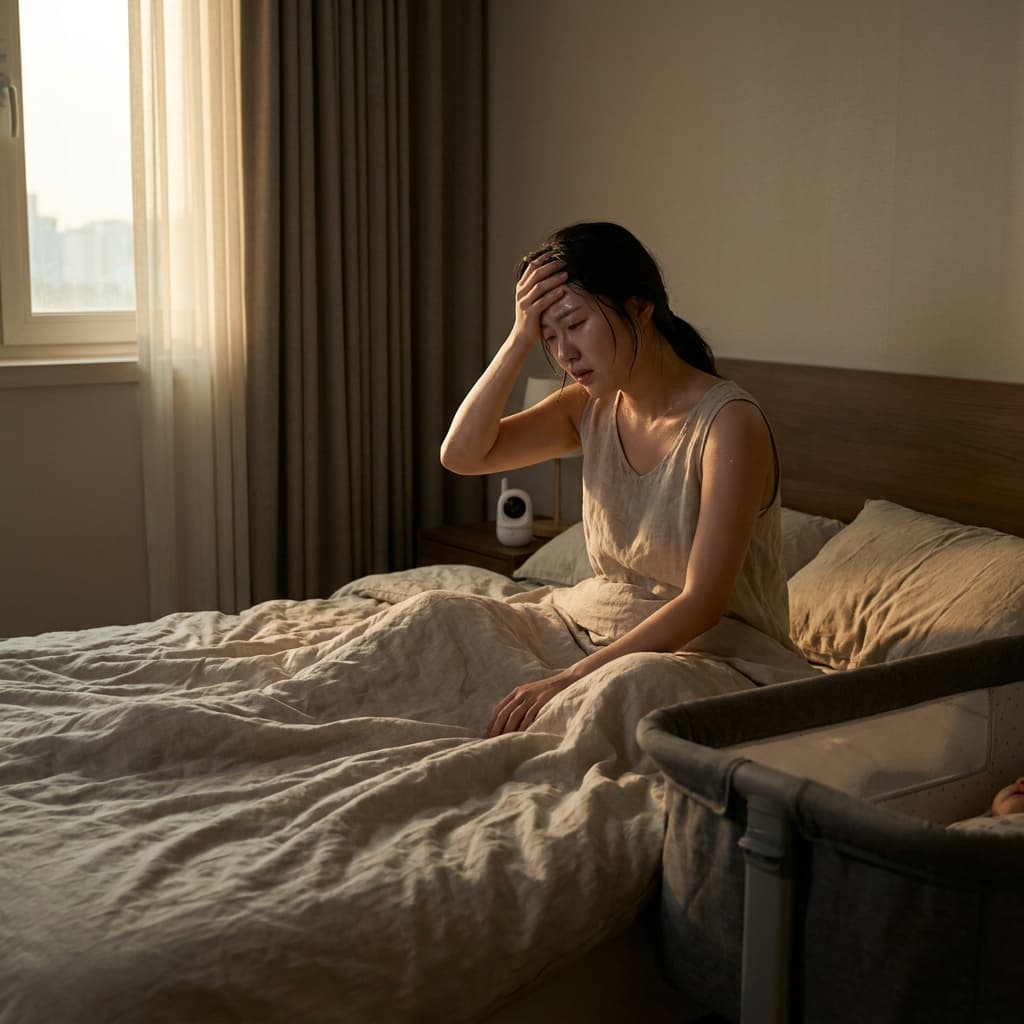
After embracing new life and going through the miraculous process of childbirth, many new mothers face unexpected physical changes and difficulties. In particular, "night sweats after childbirth" is one of the common symptoms many complain about. Day and night, even while sleeping at night, sweating so much that clothes and blankets are soaked leads to sleeplessness and a vicious cycle of further depleted physical strength. Many mothers worry alone, thinking, "Do others seem fine, but I'm the only one struggling like this?" However, these symptoms are not something you have to handle alone.
💡 [Key Answer] The 3 most common causes of night sweats after childbirth: ① Rapid hormonal changes / ② Elimination of unnecessary body water / ③ Autonomic nervous system imbalance due to Qi and Blood exhaustion Dalimchae Oriental Clinic improves excessive sweating symptoms by restoring depleted physical strength and balancing the autonomic nervous system through constitutional improvement treatment.
Why do night sweats occur so much after childbirth, and how long do they last?
Night sweats after childbirth are a natural physical response experienced by the majority of mothers, but understanding the cause can relieve unnecessary anxiety. The main causes include the rapid decrease after childbirth of female hormones like estrogen and progesterone, which had surged during pregnancy. These hormonal changes affect the hypothalamus, the body's thermostatic center, bringing temporary confusion to thermoregulation functions much like a menopausal woman. In addition, excessive water accumulated in the body, including blood volume which increased by about 50% during pregnancy, is eliminated through sweating. Especially when breastfeeding, the prolactin hormone keeps estrogen levels low, causing night sweats to last longer.
According to studies, about 29% of women experience hot flashes including nighttime sweating after childbirth, most commonly around 2 weeks postpartum and decreasing to about 14% at 12 weeks. However, it is known that about 10% of mothers still complain of postpartum night sweats 1 year after childbirth. Because individual differences are large, active management is needed rather than the vague expectation that time will heal it. It is especially important to consult medical staff if night sweats persist for more than 4 weeks or are accompanied by other symptoms such as fever or chills.
Postpartum Night Sweats: Just a Hormonal Problem? An Oriental Medicine Perspective
Western medicine mainly views hormonal changes and fluid elimination as the main causes of postpartum night sweats, but Oriental medicine views this from a broader perspective. Childbirth causes tremendous Qi and Blood (氣血) depletion and Jin-Ye (津液) deficiency in the mother's body, making the overall bodily balance prone to disruption. In particular, if physical strength becomes weak and Blood Stasis (瘀血) stagnates after childbirth, insufficient postpartum care can develop into exhaustion symptoms such as 'Yukro (蓐勞)' or postpartum fatigue (産後虛勞), often accompanied by night sweats.
A clinical study published in 2013 conducted a prospective evaluation of nighttime hot flashes during pregnancy and postpartum in 429 women. According to the study results, 29% of women reported nighttime hot flashes after childbirth, which showed a significant association with depressive symptoms (odds ratio 1.19; 95% CI, 1.14-1.25), lower education level, and higher pre-pregnancy body mass index. The researchers concluded that these results share predictive variables similar to menopausal symptoms and suggested that the roles of hormonal and emotional factors should be further explored. This suggests that postpartum night sweats are closely connected to emotional factors such as postpartum depression beyond simple physical problems.
The column "Do Oriental Medical Treatments for Postpartum Syndrome and Care Have Effects?" published in Health Chosun in May 2022 introduced a qualitative study analyzing the experiences of 8 mothers who participated in the Oriental postpartum health care support project conducted at the National Medical Center. Through this study, it was confirmed that Oriental postpartum care had positive effects on overall health management, such as postpartum syndrome symptom management, lochia discharge, reduction of pain and cold sensation, warming the body, strengthening physical strength, and appetite recovery. Notably, the counseling process with the Oriental medicine doctor provided psychological stability to the mothers. Based on these data, Dalimchae Oriental Clinic approaches postpartum night sweats not as a simple hormonal change, but through constitutional improvement treatment that corrects Qi and Blood imbalance and autonomic nervous system confusion along with overall physical recovery.
Postpartum Night Sweats: Could It Be Early Postpartum Syndrome? Self-Checklist
Night sweats after childbirth may be one of the early symptoms of postpartum syndrome. Check your condition with the checklist below, and if many apply, we recommend consulting an expert at Dalimchae Oriental Clinic Incheon Branch.
✅ Postpartum Night Sweats and Postpartum Syndrome Self-Checklist
- When sleeping at night, clothes and blankets are soaked with sweat.
- Even during the day while resting, you sweat a lot from your back, hands, or feet.
- You frequently feel chills or cold sensations along with sweating.
- You tire more easily than usual and feel your physical strength has dropped.
- Your joints feel cold or ache.
- You frequently experience unexplained depression or anxiety.
- Indigestion, loss of appetite, or swelling in arms and legs occur.
Criteria:
- 3+ items: Suspected postpartum physical exhaustion & autonomic imbalance → Review Oriental diagnosis and treatment.
- 5+ items: Postpartum syndrome risk group → Immediate clinic visit and professional medical care recommended.
Dalimchae Oriental Clinic's Constitutional Improvement Treatment: Creating a Body That Doesn't Turn Back Symptoms
Dalimchae Oriental Clinic aims for constitutional improvement to find the root of symptoms and help the body recover itself and prevent recurrence, rather than simply suppressing postpartum symptoms like night sweats. After childbirth, the balance of the autonomic nervous system is easily disrupted along with rapid hormonal changes. The autonomic nervous system plays an important role in regulating various biological functions such as body temperature regulation, sweat secretion, digestion, and sleep. When this balance breaks, the brain cannot rest and abnormalities occur in body regulation functions, leading to excessive sweating, hot flashes, lethargy, and anxiety. In particular, rapidly depleted Qi and Blood after childbirth can further intensify autonomic instability.
Dalimchae Oriental Clinic's constitutional improvement treatment proceeds with the following principles. By carefully diagnosing each mother's constitution and health condition, customized herbal medicine is prescribed to replenish Qi and Blood consumed by childbirth, remove blood stasis, and help the recovery of the uterus and the whole body. In addition, Oriental treatments such as acupuncture, moxibustion, and pharmacopuncture stabilize the weakened autonomic nervous system function and smooth body circulation to control excessive sweat secretion and help regain overall body balance. Through this, mothers can regain self-recovery capacity, improving not only sweating symptoms but also accompanying fatigue, cold sensation, pain, and postpartum depression. Dalimchae Oriental Clinic Incheon Branch prioritizes mother's health and promises meticulous care for healthy postpartum recovery.
FAQ: Frequently Asked Questions About Postpartum Night Sweats
Q. How long do night sweats after childbirth take to stop? A. While individual differences are large, they are usually most severe within 2 weeks after childbirth and tend to gradually decrease up to 12 weeks. When breastfeeding, estrogen levels remain low, which can make them last a bit longer. If they persist for more than 4 weeks or cause significant discomfort, it is recommended to get a checkup.
Q. Are postpartum night sweats related to postpartum depression? A. Yes, there may be a connection. According to studies, postpartum night hot flashes are associated with high depressive symptoms. Since physical discomfort leads to emotional difficulty and vice versa, integrated management is important.
Q. Can postpartum night sweats heal naturally? A. In many cases, they naturally improve over time. However, when symptoms are severe or persist for a long time, or are accompanied by other postpartum syndrome symptoms, active management is needed. Waiting for natural recovery can make symptoms chronic, so listen to your body's signals.
Q. How does Dalimchae Oriental Clinic treat postpartum night sweats? A. Dalimchae Oriental Clinic Incheon Branch accurately diagnoses the mother's constitution and symptoms, prescribing customized herbal medicine to replenish Qi and Blood, restore autonomic balance, and control excessive sweat. We also provide treatments to improve systemic circulation and enhance immunity with acupuncture, moxibustion, and pharmacopuncture to strengthen overall body recovery.
Postpartum night sweats are not a problem solved by enduring. You no longer need to ignore the signals your body has sent for a long time. Approaching in the right direction makes the body react faster than you think. Bring the symptoms you are experiencing as they are. Dalimchae Oriental Clinic will find the cause together.
Where life blossoms. Herbal medicine is Dalimchae Oriental Clinic. Check your symptoms first with Dalimchae Oriental Clinic's homepage AI consultation!
Medical Supervision | Women's & Pregnancy Care Standard, Dalimchae Oriental Clinic Incheon Branch, Oriental Medical Doctor Yang Yu-chan
#postpartumnightsweats #postpartsyndrome #postpartumcare #incheonclinic #constitutionalimprovement #postpartumherbs #autonomicnervous #incheonorientalclinic Fertility & Postpartum - Fertility Preparation