
Hello, this is Dalimchae Korean Medicine Clinic.
Bloated Stomach Right After Eating, Could It Be Because of 'This'?
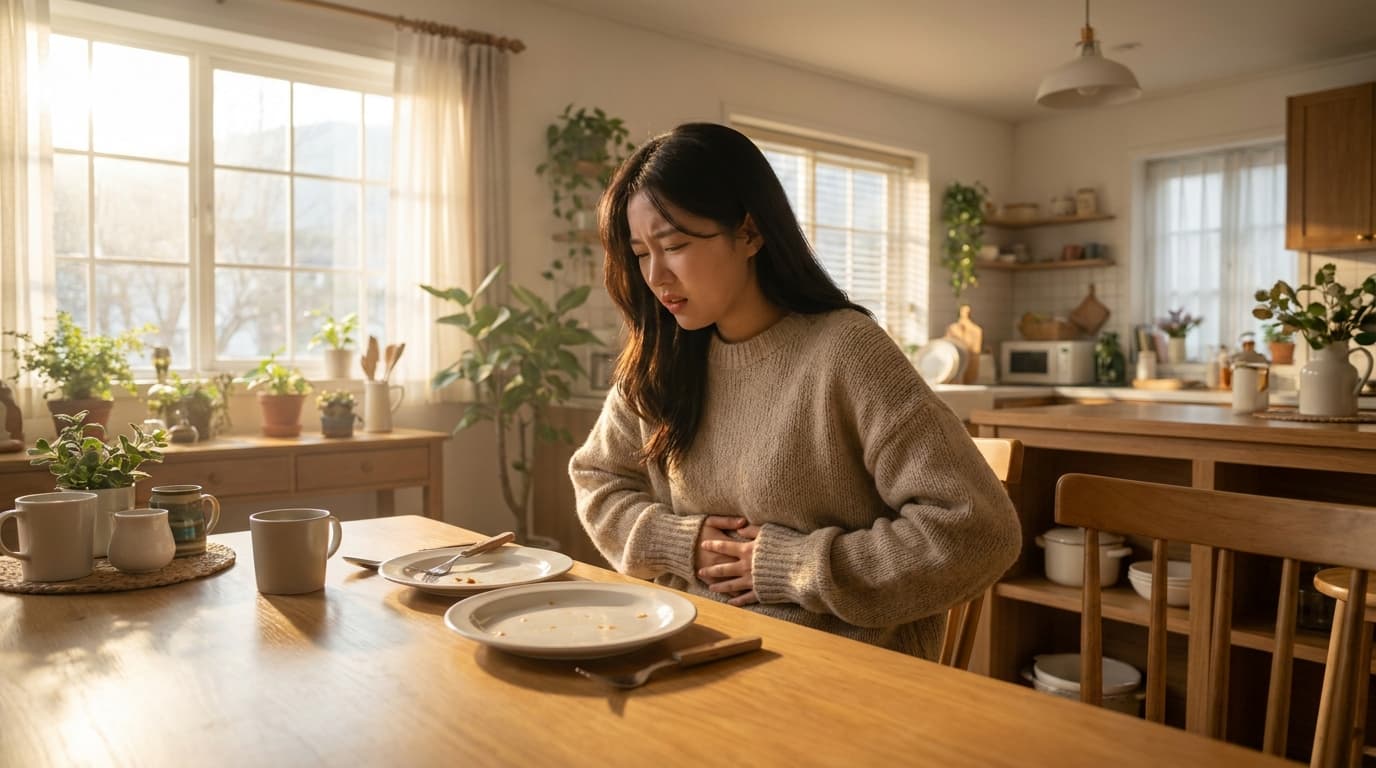
After eating a warm meal, you should feel comfortable and hearty, but do you frequently experience a stuffy feeling at the end of your sternum and your stomach swelling up like a balloon? When you feel unusually bloated and uncomfortable compared to the amount you ate, mealtime can sometimes feel painful. You might even lose sleep because of the un-digested feeling until bedtime. Many people worry that it might be a big disease because of the recurring symptoms that are hard to dismiss as simple indigestion.
💡 [Key Answer] Top 3 most common causes of bloated stomach after eating: ① Reduced gastrointestinal function & peristalsis abnormalities / ② Gut microbiota imbalance / ③ 위장 외벽 hardening due to 'Damjeok disease' (Toxin accumulation) Dalimchae Korean Medicine Clinic helps restore gastrointestinal function and improve fundamental digestive capacity through Bowel Detoxification.
Bloated Stomach After Eating, Could It Not Be Simple Indigestion?
Yes, exactly. The symptom of bloating right after eating can be deeply related to 'functional dyspepsia' beyond simple indigestion, or 'Damjeok disease' in Korean medicine. Functional dyspepsia is a condition where no special organic abnormalities are found in upper gastrointestinal endoscopy or other tests, but patients suffer from chronic and recurring upper gastrointestinal discomfort (upper abdominal fullness, early satiety, epigastric pain, heartburn, etc.). According to domestic studies, about 20.4% of the general population undergoing health checkups suffer from functional dyspepsia, which is higher than the global average.
The causes of such functional dyspepsia vary, but recent studies highlight gastrointestinal motility disorders, gastric acid hypersecretion, low-grade duodenal inflammation, gut microbiota imbalance, and abnormalities in the 'Gut-Brain Axis' as important pathophysiological mechanisms. In particular, Small Intestinal Bacterial Overgrowth (SIBO) frequently appears in functional dyspepsia patients, and this tends to be proportional to abdominal bloating.
What Is 'Damjeok Disease' Mentioned in Korean Medicine?
In Korean medicine, the symptoms of bloating, stuffiness, and discomfort in the stomach right after eating are not viewed solely as a problem of the stomach itself. In particular, chronic digestive symptoms whose causes are not clearly identified even by upper endoscopy are explained by the concept of 'Damjeok disease (痰積病)'. Damjeok is considered when undigested waste or residue accumulates in the body due to smooth digestion failure, stress, or irregular lifestyle habits, turning into 'Dam (痰)', which hinders the flow of Qi and blood, hardens the outer wall of the stomach, and forms 'Jeok (積)'.
Such Damjeok toxins accumulated on the outer wall of the stomach hinder the normal peristaltic movement of the stomach and inhibit digestive enzyme secretion, adversely affecting overall digestive function. It can lead not only to digestive symptoms such as abdominal bloating, stuffiness, frequent burping, and nausea, but also to systemic symptoms such as heavy and fatigued body, headaches, shoulder stiffness, and even depression or anxiety. This connects with the Gut-Brain Axis theory that Dalimchae Korean Medicine Clinic considers important. Just as intestinal problems affect brain function and systemic health, when Damjeok accumulates and deteriorates bowel function, it can induce systemic symptoms. Therefore, Songdo Damjeok Korean Medicine Clinic approaches this Damjeok disease not as a simple gastrointestinal disease, but as a problem of systemic circulation.
How Does Herbal Medicine Treatment Help Improve the Bloated Stomach Symptom After Eating?
Functional dyspepsia and the resulting abdominal bloating often recur or are stubborn despite Western medical treatments. At this time, herbal medicine treatment shows meaningful effects in improving symptoms by treating the root cause.
According to a study published in the <Journal of Ethnopharmacology> in 2023, when Naesohwajung-tang, an herbal medicine prescription, was administered to 116 functional dyspepsia patients for 4 weeks, total dyspepsia symptoms significantly decreased compared to the placebo group (p \< 0.05). In particular, it showed higher improvement in symptoms such as postprandial fullness, early satiety, and epigastric burning (p \< 0.05), and the Naesohwajung-tang intake group showed a greater effect than the placebo group in preventing the decrease in the ratio of normal gastric slow waves after meals. The researchers concluded that this is the first randomized clinical trial to prove that Naesohwajung-tang is effective in relieving functional dyspepsia symptoms.
In addition, in a study by the research team of Daejeon University Daejeon Korean Oriental Hospital published in <Frontiers in Pharmacology> in 2021, Banhasasim-tang was taken for 4 weeks by stress-induced functional dyspepsia patients, and as a result, it showed statistically superior effects in subjective evaluation scales for dyspepsia compared to the placebo group. In particular, superior effects over placebo were confirmed in increasing blood concentrations of ghrelin, a hormone that promotes gastrointestinal motility and stimulates appetite. The researchers emphasized that this result is the first to confirm that the effect of Banhasasim-tang on stress-induced dyspepsia is achieved through ghrelin activation, and has great significance in presenting scientific evidence for functional dyspepsia herbal medicine treatment.
Based on these research data, Dalimchae Korean Medicine Clinic focuses on improving inflammation of the gastrointestinal tract, decreased motility, and gut environment imbalance that cause the bloated stomach symptom after eating. We aim to solve the root problem through customized herbal medicine prescriptions tailored to each patient's constitution and symptoms to normalize stomach function, enhance digestion and absorption, and help remove intestinal toxins.
Comfortable Stomach Relaxation Through Dalimchae Korean Medicine Clinic's 'Bowel Detoxification' Principle
Dalimchae Korean Medicine Clinic Songdo branch manages chronic digestive diseases such as the symptom of stomach bloating after eating through 'Bowel Detoxification' treatment. Our body's intestines go beyond simple digestive organs and play an important role in controlling immunity and systemic health. Toxins accumulated in the intestinal wall can spread throughout the body via blood, causing various inflammatory reactions and immune system disturbances. In particular, if intestinal barrier permeability increases due to stress or poor dietary habits (Leaky Gut Syndrome), undigested food debris or harmful substances can flow into the blood and cause systemic problems.
Dalimchae Korean Medicine Clinic's bowel detoxification treatment concentrates on removing toxins and waste from the gastrointestinal tract, restoring damaged intestinal mucosa, and strengthening intestinal barrier function. Through this, we create a beneficial gut microbiota environment, activate gastrointestinal peristalsis, and promote digestive enzyme secretion to help the body restore digestive function on its own. In addition, we restore the balance of the 'Gut-Brain Axis' where the intestines and brain closely influence each other, alleviating digestive symptoms caused by stress. If you are experiencing reflux esophagitis or irritable bowel syndrome together, you can expect overall digestive health improvement through bowel detoxification treatment. Solve the root cause of chronic indigestion and regain a comfortable daily life at Songdo Korean Medicine Clinic.
Bloated Stomach After Eating, Which of My Symptoms Applies? Self Checklist
If 3 or more of the following symptoms apply, you should suspect functional dyspepsia and Damjeok disease and seek diagnosis from an expert.
- Your stomach swells up unusually bloated after a meal.
- Even eating a little makes your stomach feel full and severe satiety sets in.
- Poor digestion makes the end of your sternum feel stuffy and blocked frequently.
- You feel discomfort from frequent burping or passing gas.
- You sometimes feel nauseous and sick to your stomach.
- Stool is irregular or constipation or diarrhea is frequent.
- You always feel tired and your body feels heavy.
- You have frequent headaches or stiff shoulders.
- Digestive symptoms worsen when stressed.
Criteria:
- If 3 or more apply: Suspected functional dyspepsia stage → Consider gastrointestinal function improvement and bowel detoxification treatment.
- If 5 or more apply: High possibility of chronic Damjeok disease → Immediate visit to Songdo indigestion Korean medicine clinic recommended.
FAQ: Solving Your Questions About Bloated Stomach After Eating
Q. Bloated stomach after eating, how long do I need treatment to recover? A. Treatment duration may vary depending on the degree of symptoms, chronic status, and constitution of the patient. Usually, meaningful improvement is experienced through 1 to 3 months of intensive treatment, and consistent management is important to prevent recurrence.
Q. Can my stomach be bloated even if upper endoscopy results are normal? A. Yes, it is fully possible. In the case of functional dyspepsia, upper endoscopy findings show no special organic abnormalities. This can be caused by functional problems of the gastrointestinal tract, micro-inflammation, or gut environment imbalance.
Q. Can the bloated stomach symptom improve just by improving dietary habits? A. Dietary habits improvement is very important, but for chronic symptoms, it may not be enough. Fried foods, flour, carbonated drinks, and certain fruits can induce abdominal bloating, so caution is needed. Combining herbal medicine treatment to restore overall bowel health is much more effective.
Q. I have headaches and dizziness along with the bloated stomach symptom after eating, can they be treated together? A. Yes, it is possible. In Korean medicine, gastrointestinal and systemic symptoms are connected. In particular, abnormalities in the Gut-Brain Axis can induce various systemic symptoms such as headaches, dizziness, and fatigue, so restoring systemic balance through bowel detoxification treatment can also improve these symptoms together.
A bloated stomach after eating is not a problem that can be solved by enduring it. You no longer need to ignore the body's signals you have sent for a long time. If you approach it in the right direction, your body reacts faster than you think. Bring the symptoms you are experiencing as they are. Dalimchae Korean Medicine Clinic will find the cause together.
Where life blooms. Herbal medicine is Dalimchae Korean Medicine Clinic. Check symptoms similar to yours first through the AI consultation on the Dalimchae Korean Medicine Clinic website!
Medical Supervision | Department of Gastrointestinal Medicine, Songdo Branch of Dalimchae Korean Medicine Clinic, Korean Medicine Doctor Oh Hyun-min (Abdominal Symptom Column)