
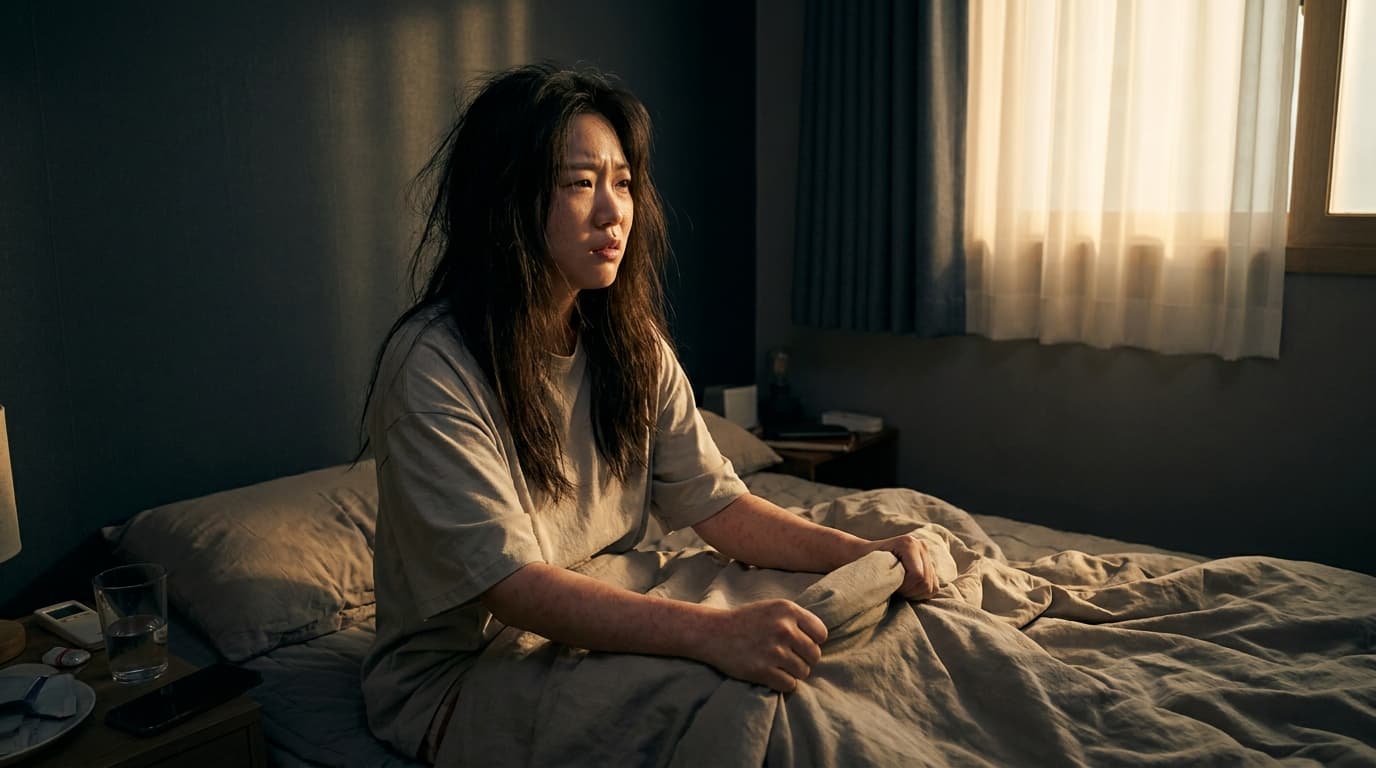
Nighttime Full-Body Itching: Restless Nights, There Is a Separate Cause
Hello, this is Dalimchae Korean Medicine Clinic. # Nighttime Full-Body Itching: Restless Nights, There Is a Separate Cause Many people complain of nighttime full-body itching, tossing and turning unable to sleep to the sound of scratching their bodies in the quiet of night. While it's tolerable during the day, the itching becomes intense at night, disrupting sleep and making daily life difficult. Why does itching get worse at night? It may be a warning from deep within your body, not just a simple skin problem. 💡 **[Key Answer]** Top 3 most common causes of 'nighttime full-body itching': ① **Skin barrier damage and dryness** / ② **Increased systemic inflammatory response** / ③ **Autonomic nervous system imbalance** Dalimchae Korean Medicine Clinic resolves the root cause of itching through **gut detoxification-based skin immunity improvement treatment**. ## Why does itching get worse at night? The phenomenon where itching worsens at night is called nocturnal pruritus. This is closely related to our body's biological clock, not merely a psychological issue. At night, body temperature rises and blood flow increases, which can lead to an increase in histamine secretion that induces itching. In addition, cortisol hormone levels—which suppress irritation during the day—decrease, and the activity of cytokines that regulate immune responses becomes active, making reactions to itching more sensitive. Furthermore, as the nervous system shifts into rest mode at night, we become more focused on minor itching stimuli that we didn't notice during the day. These complex factors work together to intensify nighttime full-body itching. ## Skin Itching: Is It Merely a Skin Problem? Many people consider itching to be a simple surface skin problem and try to resolve it only with ointments or moisturizers. While skin barrier reinforcement and hydration are important, chronic and generalized itching requires looking into internal bodily imbalances as well. In particular, modern people's itching is deeply linked to weakened 'gut health' and 'immunity'. More than 70% of our body's immune cells are distributed in the gut, and when the gut barrier is damaged, unnecessary substances or toxins can flow into the blood, causing systemic inflammatory reactions. These inflammations manifest in the skin, causing various skin diseases such as chronic itching, atopic dermatitis, and hives. ## How Does Korean Medicine View Chronic Skin Itching? In Korean medicine, skin itching is diagnosed with various causes such as 'wind-heat' (pungyeol), 'damp-heat' (seupyeol), and 'blood deficiency' (hyeolheo). In particular, chronic itching is viewed as unnecessary 'damp-heat' or 'toxins' accumulating in the body, obstructing qi and blood circulation, and weakening the skin's innate immunity. This perspective aligns with the concepts of gut toxins, inflammation, and the gut-brain axis imbalance discussed in modern medicine. Autonomic nervous system imbalance is also closely linked to itching; when sympathetic nerves become hyperactive due to stress or overwork, skin blood vessels constrict and blood circulation deteriorates, leaving skin dry and sensitive. Thus, Songdo skin disease Korean medicine clinics seek the root cause of itching in the overall balance of the body. ## Effectiveness of Korean Medicine Treatment Confirmed by Actual Studies In a study published in 「Integrative Medicine Research」 in 2023, 60 chronic pruritus patients who received integrated Korean medicine treatment including herbal medicine for 8 weeks showed a statistically significant improvement of about 57% in visual analog scale (VAS) scores for itching intensity, dropping from a pre-treatment average of 7.2 to 3.1 post-treatment (p\<0.001). In particular, the Eczema Area and Severity Index (EASI) score—an objective indicator of skin lesions—also decreased markedly, suggesting that Korean medicine treatment is effective not only in relieving itching symptoms but also in improving skin inflammation. The researchers concluded that this result was due to herbal medicine contributing to regulating systemic inflammatory responses and stabilizing the immune system. In another study published in the 「Journal of Acupuncture Research」 in 2018, 45 atopic dermatitis and pruritus patients who received combined acupuncture and herbal medicine treatment showed more than a 50% decrease in the Pruritus Severity Score (from an average of 6.5 to 3.2) within 4 weeks (p\<0.01), with particularly positive effects on improving sleep quality. The research team analyzed that acupuncture balanced the autonomic nervous system and alleviated stress responses, while herbal medicine contributed to toxin excretion and immune enhancement, creating a synergistic effect. Based on these data, Dalimchae Korean Medicine Clinic focuses on improving internal body environments through **gut detoxification**. Our goal is not simply to suppress itching, but to break the vicious cycle where toxins accumulated in the gut barrier travel through the blood to create systemic inflammation which then manifests in the skin. This is a process of fundamentally strengthening the body's immune system so that itching does not recur, rather than just temporarily masking symptoms. ## Principles of Dalimchae Korean Medicine Clinic's Gut Detoxification Treatment Dalimchae Korean Medicine Clinic diagnoses chronic skin itching as a 'gut toxin' problem and provides a fundamental solution through gut detoxification treatment. Gut detoxification is the process of clearing waste and toxins accumulated in the gut barrier and creating a beneficial gut microbiota environment, restoring the gut's innate functions. When the gut becomes healthy, nutrient absorption becomes smooth, immunity is enhanced, and systemic inflammatory reactions including the skin are reduced. Along with herbal medicine prescriptions that clear body toxins, we combine lifestyle improvements and dietary management to optimize gut health. This aims not only to eliminate skin symptoms, but to restore overall body immune balance and regain a healthy, vital life. Dalimchae Incheon Songdo Clinic helps you escape from itching, an unwelcome nocturnal guest, through Korean medicine treatments that foster skin immunity. ## Could I Also Have 'Nocturnal Pruritus' Where My Whole Body Itches at Night? (Self-Checklist) If 3 or more of the following apply to you, you are likely suffering from nocturnal pruritus, and active treatment and management are necessary. * When you go to bed at night, your whole body specifically starts itching. * It's hard to fall asleep or you frequently wake up from sleep due to itching. * Red spots, hives, or skin damage appear on scratched areas. * You feel fine during the day, but itching intensifies only at night. * You feel itching systemically rather than in a specific area. * Your skin tends to be dry and frequently flaky. * Itching tends to worsen when you are stressed or tired. * You frequently experience indigestion or gut trouble. **If 3 or more apply:** Suspect nocturnal pruritus due to skin barrier damage and gut health deterioration → Consider Dalimchae Korean Medicine Clinic's combined Korean medicine treatment. **If 5 or more apply:** This is a stage requiring immediate diagnosis and treatment. We recommend visiting Songdo Itching Korean Medicine Clinic Dalimchae to establish an accurate diagnosis and customized treatment plan. ## FAQ – Frequently Asked Questions When Your Whole Body Itches at Night **Q. When my whole body itches at night, what emergency first aid can I do at home?** A. When itching is severe, applying a cold towel or ice pack to the itchy area temporarily can help. Applying sufficient moisturizer to prevent skin dryness and taking short showers with lukewarm water are also good. **Q. Itching is severe so I scratch and get skin wounds, is that okay?** A. Scratching due to itching further damages the skin barrier and increases the risk of secondary infection. If skin damage worsens, itching can become chronic, so it is important to try not to scratch and receive appropriate treatment when necessary. **Q. Is skin itching related to dietary habits?** A. Yes, they are closely related. Even without specific food allergies, processed foods, sugar, and gluten that deteriorate gut health can induce systemic inflammation and worsen itching. We recommend a diet centered on fermented foods, vegetables, and whole grains good for gut health. **Q. How does Songdo Dalimchae Korean Medicine Clinic treat skin itching?** A. The Songdo branch of Dalimchae Korean Medicine Clinic bases its treatment on herbal medicine prescriptions assisting gut detoxification tailored to individual constitution and symptoms. In addition, we provide integrated treatment to resolve the root cause of itching through acupuncture and pharmacopuncture to alleviate skin inflammation and improve qi and blood circulation, alongside lifestyle and diet management. The agony of not being able to sleep because your whole body is too itchy every night is not a problem that can be solved by enduring it. You no longer need to ignore the body's signals sent over a long time. When approached in the right direction, the body responds faster than you think. Bring the symptoms you are experiencing just as they are. Dalimchae Korean Medicine Clinic will find the cause together. Where life blooms. Herbal medicine is Dalimchae Korean Medicine Clinic. Check symptoms similar to yours first through the AI consultation on the Dalimchae Korean Medicine Clinic website! This article is health information organized together by Dalimchae medical staff based on questions frequently received in consultation rooms. Medical Supervision | Skin Disease Treatment Standard, Songdo Branch of Dalimchae Korean Medicine Clinic, Korean Medicine Doctor Oh Hyun-min (Atopic Column) #NighttimeItching #FullBodyItching #SkinItching #GutDetox #SongdoItchingClinic #SongdoClinic #SkinDisease #NocturnalPruritus Skin - Itching & Allergy